
Satellite Doppler calculator
Live Doppler-corrected frequencies for every pass — plus a quick calculator for any frequency and speed. 15,000+ satellites · live

SkyLive for iPhone & Android
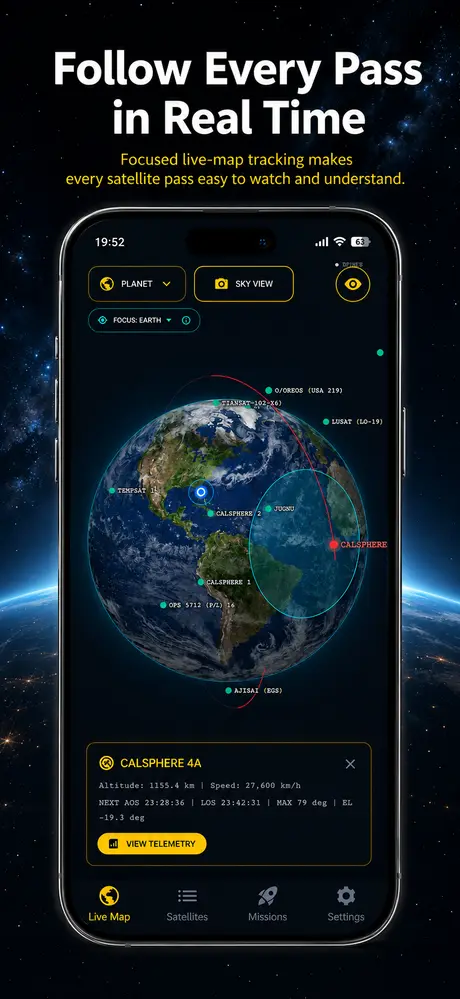
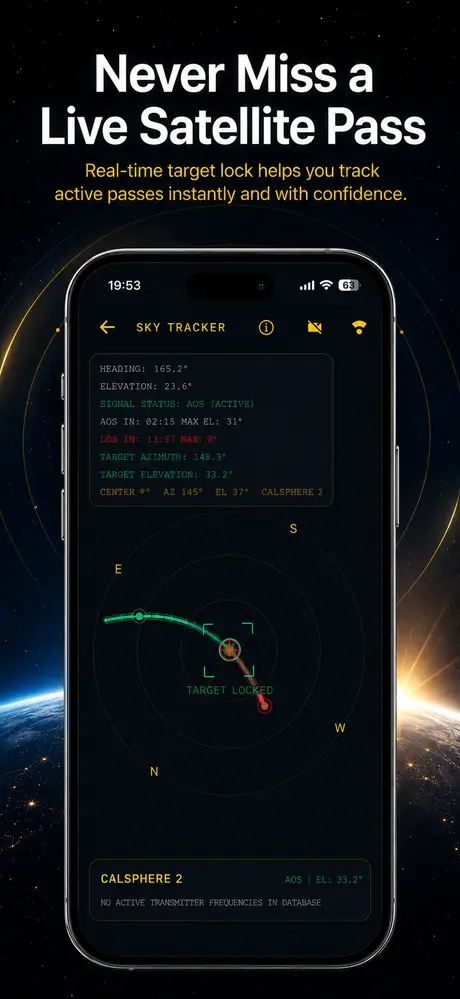
Never miss a pass again
- Alerts minutes before the ISS or Starlink flies over you
- AR sky view — point your phone to find satellites and planets
- Lock-screen Live Activity countdown and home-screen widgets
- Offline tracking, missions timeline and 3D planet explorer
- Syncs your ground station and favorites with this website
 Scan with your phone camera
to install SkyLive free.
Free tools
Everything you need to watch the sky
3D Earth, live
15,000+ satellites on a day/night globe with orbit paths, propagated every second in WebAssembly.
Pass predictions
Rise, peak and set for the next 7 days with naked-eye visibility and calendar reminders.
Tonight's sky
Moon phase, visible planets, darkness and an hourly cloud-cover forecast for your location.
Live solar system
Real planet positions with time travel, distances and rise/set times.
Sky radar
Every satellite above your horizon right now, with the Sun, Moon and planets.
Ham radio Doppler
SatNOGS transmitters with live Doppler-corrected uplink and downlink.
AR sky view
Point your phone at the sky to label satellites and planets.
In the appPass alerts
Notifications and Live Activities before every visible pass.
In the appQuick Doppler shift calculator
Enter the satellite’s nominal frequency and its range rate relative to you. A satellite approaching you (negative range rate) is heard higher than its nominal frequency; as it recedes after the closest point of the pass, it drops lower. For a low-Earth-orbit satellite the range rate swings between about −7 and +7 km/s during a pass.
Live Doppler for real satellites
The radio tab above does this automatically: it computes the range rate from your ground station with the SGP4 engine every second and shows the corrected downlink to tune to and the pre-compensated uplink to transmit on, using transmitter data from SatNOGS. Set your exact station location for the best accuracy, and use the amateur radio satellite tracker to find FM, linear and APRS satellites to work.
Frequently asked questions
What is the Doppler shift formula for satellites?
f_received = f × (1 − v/c), where f is the transmitted frequency, v the range rate (positive when the satellite moves away) and c the speed of light. Uplink is pre-compensated with f × (1 + v/c) so the satellite receives its nominal frequency.
How large is the Doppler shift on 2 m and 70 cm?
For a LEO satellite at about 7 km/s, up to roughly ±3.4 kHz on 145 MHz and ±10 kHz on 435 MHz. The shift is largest at the start and end of a pass and passes through zero at the closest approach.
Do I need to correct Doppler on FM satellites?
On 2 m downlinks small FM shifts are often tolerable, but on 70 cm you should step the frequency several times during a pass. Linear transponder and data satellites need continuous correction.
How accurate are the satellite positions?
SkyLive propagates official two-line element sets with the SGP4/SDP4 model — the same C++ engine as the mobile apps, compiled to WebAssembly. Elements refresh daily from CelesTrak and SatNOGS, which keeps low-Earth-orbit positions within a few kilometres.
Does SkyLive sync with the mobile app?
Sign in with Google or Apple and your ground station and favorite satellites sync between the web, iPhone and Android in real time.