Starlink train tracker
Pass times for Starlink satellites over your location — find the newest launch and see when it flies over. 15,000+ satellites · live

SkyLive for iPhone & Android
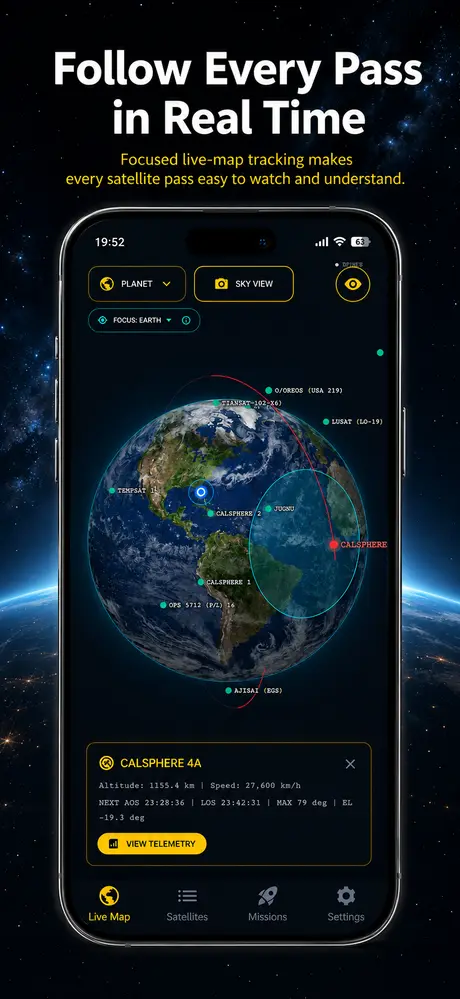
Never miss a pass again
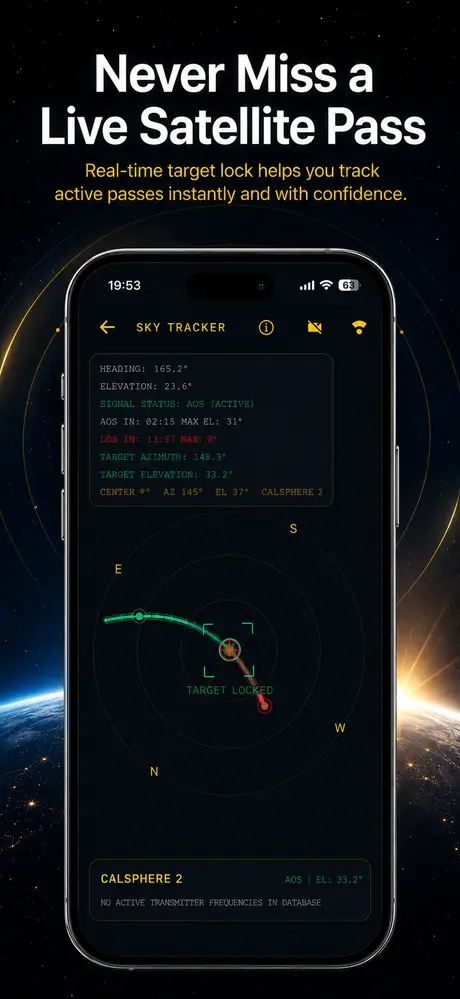
- Alerts minutes before the ISS or Starlink flies over you
- AR sky view — point your phone to find satellites and planets
- Lock-screen Live Activity countdown and home-screen widgets
- Offline tracking, missions timeline and 3D planet explorer
- Syncs your ground station and favorites with this website
 Scan with your phone camera
to install SkyLive free.
Free tools
Everything you need to watch the sky
3D Earth, live
15,000+ satellites on a day/night globe with orbit paths, propagated every second in WebAssembly.
Pass predictions
Rise, peak and set for the next 7 days with naked-eye visibility and calendar reminders.
Tonight's sky
Moon phase, visible planets, darkness and an hourly cloud-cover forecast for your location.
Live solar system
Real planet positions with time travel, distances and rise/set times.
Sky radar
Every satellite above your horizon right now, with the Sun, Moon and planets.
Ham radio Doppler
SatNOGS transmitters with live Doppler-corrected uplink and downlink.
AR sky view
Point your phone at the sky to label satellites and planets.
In the appPass alerts
Notifications and Live Activities before every visible pass.
In the appWhen can I see a Starlink train?
A Starlink train is a line of satellites from one launch, still bunched together on their way to their working orbit. A Falcon 9 typically deploys a couple of dozen at once, and for the first days they cross the sky in an evenly spaced string of steady, moving lights. This page lists the Starlink category so you can pick the newest satellites and read their pass times for your exact location.
How to find tonight’s train
- Allow location access or enter your city so passes are computed for your sky.
- Search the catalog for the newest Starlink group — the highest satellite numbers are the most recent launches.
- Open the pass table and look for passes marked ★ visible: sunlit satellites against a dark sky, usually within two hours of sunset or before sunrise.
- Go outside five minutes early and look toward the rise direction. Trains do not blink and travel in a straight line.
Why trains fade
Within a couple of weeks the satellites raise their orbits, spread out and orient their panels to reduce reflected light, so the “train” becomes a scatter of faint dots. Recent satellite designs are also dimmer than the early ones, so trains today are subtler than in 2019–2020. Use the live Starlink map to see how the constellation looks overall.
Frequently asked questions
How long does a Starlink train stay visible?
Usually one to two weeks after launch. As the satellites climb to their operating altitude they spread out and become much harder to spot.
What time is the Starlink train tonight?
It depends on your location. Select the newest Starlink satellite and open the pass table: the ★ rows are the times it will be visible from where you are.
Is a Starlink train the same as the ISS?
No. The ISS is a single, very bright light that never blinks and crosses the sky in a few minutes; a Starlink train is many fainter lights in a line. Check the ISS tracker to rule it out.
How accurate are the satellite positions?
SkyLive propagates official two-line element sets with the SGP4/SDP4 model — the same C++ engine as the mobile apps, compiled to WebAssembly. Elements refresh daily from CelesTrak and SatNOGS, which keeps low-Earth-orbit positions within a few kilometres.
Does SkyLive sync with the mobile app?
Sign in with Google or Apple and your ground station and favorite satellites sync between the web, iPhone and Android in real time.