The solar system, live
Real planet positions for today — drag to orbit, tap a planet, time-travel with the controls. 15,000+ satellites · live

SkyLive for iPhone & Android
Never miss a pass again
- Alerts minutes before the ISS or Starlink flies over you
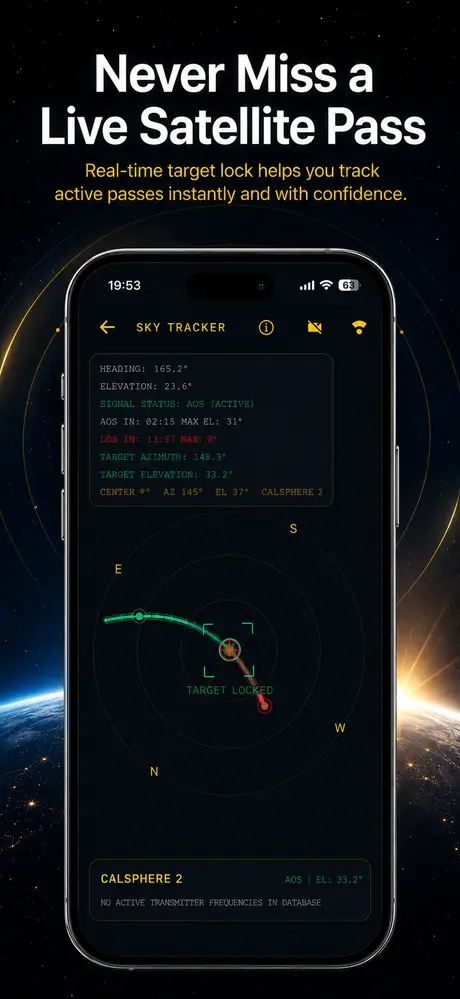
- AR sky view — point your phone to find satellites and planets
- Lock-screen Live Activity countdown and home-screen widgets
- Offline tracking, missions timeline and 3D planet explorer
- Syncs your ground station and favorites with this website
 Scan with your phone camera
to install SkyLive free.
Free tools
Everything you need to watch the sky
3D Earth, live
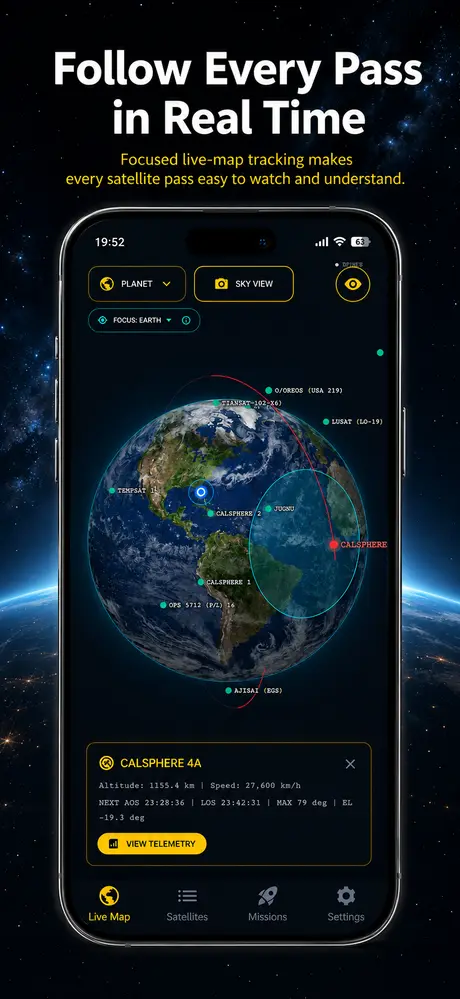
15,000+ satellites on a day/night globe with orbit paths, propagated every second in WebAssembly.
Pass predictions
Rise, peak and set for the next 7 days with naked-eye visibility and calendar reminders.
Tonight's sky
Moon phase, visible planets, darkness and an hourly cloud-cover forecast for your location.
Live solar system
Real planet positions with time travel, distances and rise/set times.
Sky radar
Every satellite above your horizon right now, with the Sun, Moon and planets.
Ham radio Doppler
SatNOGS transmitters with live Doppler-corrected uplink and downlink.
AR sky view
Point your phone at the sky to label satellites and planets.
In the appPass alerts
Notifications and Live Activities before every visible pass.
In the appWhere are the planets right now?
Positions come from NASA JPL’s Keplerian elements for the major planets, computed for the current moment. Distances are compressed so the outer planets fit on screen; sizes are exaggerated. Tap a planet for its distance from Earth and the Sun, light-travel time, and when it rises and sets for you.
Time travel
Use 1d/s or 1mo/s to watch the inner planets lap the outer ones, find upcoming oppositions, or see why Mars appears to move backwards in our sky.
Frequently asked questions
How far is Mars from Earth today?
Select Mars in the solar system view — the panel shows today’s distance in AU and kilometres and the one-way light time.
Are the planet positions accurate?
They use JPL’s approximate Keplerian elements, accurate to about an arcminute for 1800–2050 — easily enough to find planets in the sky.